So You Want a basic skincare routine that actually works? (Without spending your whole paycheck)
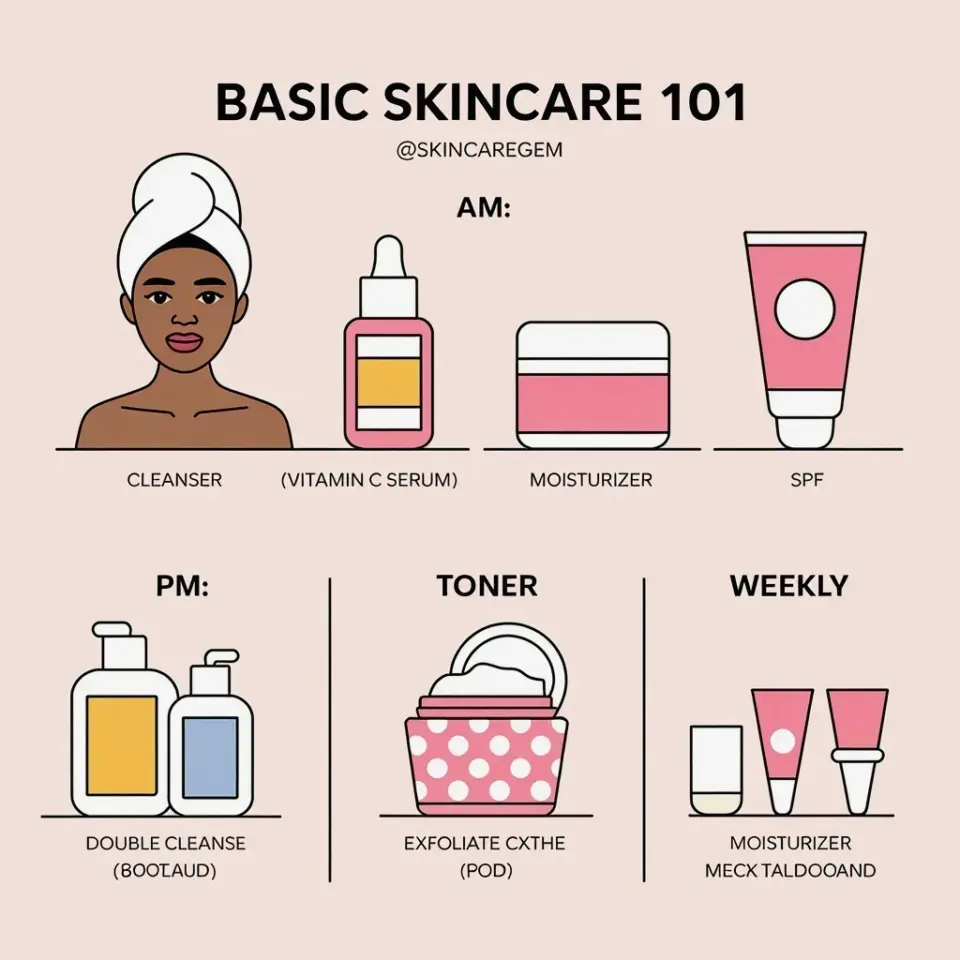
Look, I get it. Every time I scroll through social media, there’s some new 10-step routine with $80 serums that promise to reverse time. It’s exhausting. Honestly, it’s also a little insulting. You don’t need a chemistry degree or a second mortgage to take care of your face. A simple skincareroutine with drugstore favorites works just as well as the fancy stuff. But the problem isn’t the products. It’s the mistakes people make before they even open a bottle. So let’s talk about the common pitfalls and how to dodge them, using the exact basic routine from that pink infographic you saved (yes, the one with the person in the white towel and the Vitamin C dropper).
I’ve been doing this for years and I still mess up sometimes. Last week I slathered on a thick night cream in the morning and looked like a glazed donut by noon. Not cute. But I learned. And you can too.
Mistake #1: Starting with too many products (and ignoring the bare bones)
Here’s the thing: you don’t need a toner, an essence, an ampoule, and a sheet mask every single day. Not gonna lie, I used to think I did. I bought all the hype. My bathroom shelf looked like a Sephora explosion. But my skin got worse. Why? Because I layered so much stuff that nothing could sink in. The real skincare101 moves in the infographic show only four products for the AM routine: cleanser, Vitamin C serum, moisturizer, and SPF. That’s it. Four. You can do four.
Mistake people make: they skip the SPF because they think moisturizer with SPF 15 is enough. Or they buy a vitamin C serum that costs $50 and then use it once a week. No. Stick to the basics. A cheap vitamin C serum from the drugstore (Vitamin C serum text right next to the dropper in the image) works fine if it’s fresh and stored in a dark bottle. If you can’t afford a separate SPF, get a moisturizer with at least SPF 30. But really, just get the SPF. Your future self will thank you.
And for the PM routine in the infographic? It’s even simpler. Cleanser, maybe a treatment (like retinol or a gentle exfoliant a few nights a week), moisturizer. That’s the whole thing. Don’t overthink it.
Mistake #2: Washing your face too aggressively (both morning and night)
Ok so let me ask you something. Are you scrubbing your face like you’re trying to remove a stain from a frying pan? Because if your cleanser makes your skin feel tight or squeaky, you’ve gone too far. That squeak is your skin barrier crying for help. The AM part of the infographic shows “CLEANSER” in bold, but it doesn’t specify scrubbing or exfoliating. That’s intentional. Morning cleansing should be gentle. Use lukewarm water, a soft cleanser, and your bare hands or a soft cloth. No exfoliating gloves. No mega-grainy scrubs.
Little hyper-specific detail: I once used a charcoal scrub every morning for a week because I thought “deep clean” meant better. My face looked like a tomato with tiny cuts. Don’t be me. Be the calm person in the infographic with the white towel and peaceful expression. You don’t need to fight your face.
- AM cleanser: Pick a gentle gel or cream formula. CeraVe Hydrating Cleanser is cheap and works.
- PM cleanser: If you wear makeup or sunscreen, double cleanse. Oil cleanser first, then a gentle second cleanser. Or use a micellar water. Don’t skip this step unless you like clogged pores.
- Weekly step (from the infographic): A gentle chemical exfoliant (like lactic acid or salicylic acid) once a week. Not a scrub. Not a brush. Just a swipe of a liquid pad or a thin layer of a serum.
Remember, the infographic has a “WEEKLY:” section. That’s your one exfoliation or mask moment. Don’t make it a daily thing unless you want to regret everything.
Mistake #3: Using vitamin C serum wrong (and then blaming the product)
Vitamin C serum is great. Really great. In the infographic, they show a dropper bottle with “SERUM (Vitamin C serum)” written next to it. But here’s where people go wrong: they apply it to dirty skin, or they put it on top of other products, or they mix it with niacinamide and then wonder why their face stings. Look, vitamin C works best on clean, slightly damp skin. After your cleanser, pat your face dry (or leave it a little damp, but not dripping). Then apply 3-4 drops of the serum. Let it sink in for 30 seconds. Then moisturizer. Then SPF.
Another mistake: buying a huge bottle of vitamin C that turns orange after two weeks. The cheap ones often oxidize faster. Solution? Buy a small bottle. Keep it in the fridge if you can. Or look for a stabilized formula (like L-ascorbic acid with vitamin E and ferulic acid mixed in). The Ordinary makes a decent one for under $10. That’s affordableskincare at its finest.
I have a weird personal rule: I never buy a vitamin C serum that comes in a clear glass dropper bottle unless I plan to use it within a month. The pink jar in the infographic? That’s a moisturizer, not a serum. Serums need dark or opaque packaging. If you see a vitamin C in a clear bottle on a shelf, run away. It’s already dead.
Mistake #4: Forgetting that your night routine needs moisture (especially if you use acne treatments)
The PM routine in the infographic is simple: cleanser, maybe a treatment, then moisturizer. But people with oily or acne-prone skin often skip the moisturizer at night because they think it will make them break out. Wrong. So wrong. When you strip your skin with benzoyl peroxide or salicylic acid and don’t replace the moisture, your skin panics and produces even more oil. It’s a vicious cycle.
Here’s a skincaretips gem: use a moisturizer that contains ceramides or squalane. They’re cheap. The brand Vanicream makes a daily facial moisturizer that costs about $10 and won’t clog pores. Slather it on at night, especially around your eyes and lips. And don’t forget your neck. The cartoon person in the infographic only shows the face, but your neck gets just as much sun and aging.
Also, stop treating the PM routine like a science experiment. You don’t need to rotate seven different serums. Pick one active ingredient per night. Retinol one night, a hydrating serum the next, maybe niacinamide on the off-nights. Keep it simple. Your brain and your skin will thank you.
Mistake #5: Ignoring the order of application (yes, it matters)
This is such a boring mistake but it ruins everything. The infographic shows the AM routine in order: CLEANSER, SERUM, MOISTURIZER, SPF. That’s the correct order: thinnest to thickest. If you put a thick moisturizer on first, the serum can’t penetrate. It just sits on top and gets wiped off by your pillow.
For PM, the order is similar: cleanser, treatment (if any), moisturizer. If you use a retinol, apply it after cleansing on a dry face. Wait 20 minutes if you have sensitive skin, then moisturizer. If you use an oil or a heavier cream, that goes last. Always.
And here’s a weird tangent that might help: I used to mix my moisturizer with my SPF to save time. Don’t do it. It dilutes the SPF and you end up with patchy protection. Apply them separately. Let the moisturizer sink in for a minute, then apply SPF. The infographic probably doesn’t show that little wait time, but trust me, it’s the difference between UV protection that works and one that doesn’t.
Mistake #6: Skipping the weekly step because you’re “too busy”
The infographic has a “WEEKLY:” section. It’s not just decoration. That weekly step is your deep cleanse or your exfoliation or your hydrating mask. People skip this and then wonder why their skin looks dull or clogged. Look, you don’t need to do a full 20-minute sheet mask ritual. A 5-minute lactic acid peel pad, a clay mask on your T-zone, or even just a vinegar-toner splash can make a difference.
For basicroutine on a budget, buy a single jar of something like The Ordinary’s AHA 30% + BHA 2% peeling solution (it’s red, looks intimidating). Use it once a week for exactly 10 minutes. Rinse. Follow with moisturizer. That’s your weekly step. Done. No need for a whole spa setup.
One more thing: the infographic background is pink. That’s cute but it doesn’t mean anything for your skin. Don’t buy products because the packaging matches your bathroom tiles. Buy them because they work and they’re cheap. That’s the whole point of this.
So what does a realistic budget-friendly routine look like?
Let me give you a concrete example, matching the infographic exactly. You can find all of these at a drugstore or online for under $30 total.
- AM cleanser: CeraVe Hydrating Cream-to-Foam Cleanser (around $8)
- AM serum: The Ordinary Ascorbic Acid 8% + Alpha Arbutin 2% (around $10)
- AM moisturizer: Cetaphil Daily Hydrating Lotion (around $10)
- AM SPF: La Roche-Posay Anthelios Mineral SPF 50 (around $12, but lasts months)
- PM cleanser: Garnier Micellar Water (around $6)
- PM moisturizer: Simple Rich Moisturizer (around $8)
- Weekly exfoliant: Stridex red box pads (around $5 for a pack of 90)
That’s a affordableskincare list for about $50 total, and it’ll last you at least two months. You don’t need a separate eye cream, a toner, or a face mist. Those are nice, but they’re not necessary. The infographic is right: just cleanser, vitamin C, moisturizer, SPF, and a weekly step. That’s your whole map.
If you want to add a PM treatment later, consider a retinol like The Ordinary Retinol 0.2% in Squalane (under $6). Use it twice a week to start. But don’t buy everything at once. Start with the basics. Master them. Save the rest of your money for, I don’t know, groceries or something.
Wrapping this up (but keep it simple)
Look, skincare is not a competition. It’s not about who has the most bottles. It’s about being consistent and not hurting your own skin. The infographic you saved is a perfect cheat sheet. Print it out. Stick it on your mirror. Follow it. And when you feel tempted to buy a 12-step kit from an Instagram ad, remember that the person in the cartoon is calm, relaxed, and using just four things in the morning. Be that person.
Now go wash your face and save this article for your next drugstore run. And maybe buy a backup of that vitamin C while you’re at it.
#skincareroutine #skincare101 #affordableskincare #skincaretips #basicroutine
Leave a Comment