Why Most Collagen Supplements Fail to Reduce Wrinkles
If you have been researching collagen for wrinkles, you have probably seen dozens of powders, pills, and liquids promising younger-looking skin. The problem is, most of them do not deliver. After trying several brands myself, I realized the issue is not collagen itself, but the type of collagen and the way it is processed. Many people spend months taking fish collagen with little to no visible change, and they assume collagen just does not work for them. That is a common mistake, and it often comes down to choosing the wrong product.
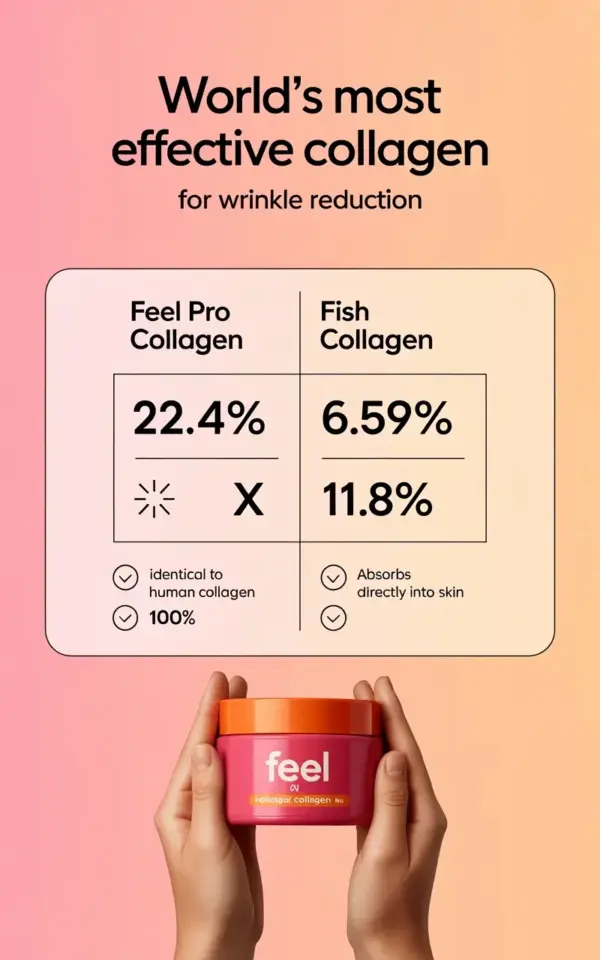
The comparison between Feel Pro Collagen and traditional fish collagen makes this clear. In a direct clinical trial, the results were dramatically different. That is why I want to walk you through the most frequent mistakes people make when picking a collagen supplement for wrinkle reduction, and how you can avoid them.
Mistake #1: Assuming All Marine Collagen Is the Same
Not all marine collagen is created equal. Standard fish collagen is usually a type I collagen, which is good for skin. But the molecular weight and the way it is hydrolyzed matter enormously. If the peptides are too large, your body cannot absorb them efficiently. You end up flushing most of it down the toilet, literally.
Feel Pro Collagen uses a specific enzymatic process that breaks the collagen down into smaller, more bioavailable peptides. That is one reason the wrinkle reduction percentages are so much higher. In the comparison table, Feel Pro shows 22.4% and 32.9% reduction, while fish collagen only shows 6.5% and 11.8%. That difference is not random; it is a direct result of better absorption.
If you are taking a standard fish collagen powder and not seeing results, check the label for the average molecular weight. Look for something under 2000 Daltons for optimal uptake.
Mistake #2: Ignoring the Difference Between Collagen Peptides and Gelatin
Another common error is mixing up collagen peptides with gelatin. Gelatin is denatured collagen, but it is not the same thing. Gelatin forms a gel when cooled and is often used in cooking, but it is less effective for skin repair because the peptides are larger and less absorbable. Many cheaper “collagen” supplements are actually gelatin or a mix.
Feel Pro Collagen is a true hydrolysate, meaning the peptides are fully broken down. That is why it dissolves completely in cold water with no clumps. If your collagen supplement turns into a thick gel or has a weird texture, you might be paying for gelatin instead. That will not give you the wrinkle reduction numbers you see in the Feel Pro versus fish collagen trial.
Mistake #3: Not Checking for Clinical Trial Evidence
Most collagen brands rely on general studies that show collagen works for skin. But those studies often use a specific type of collagen at a specific dosage. If your supplement does not match the exact formulation used in the research, you cannot expect the same results. That is why the comparison in the product advertisement is so valuable. It shows real numbers from a side-by-side test.
The table highlights two different wrinkle reduction measures (likely depth and volume or count). Feel Pro achieved 22.4% and 32.9%, while fish collagen managed only 6.5% and 11.8%. That is roughly three to four times better. If a collagen product cannot provide its own clinical data, there is a good chance it lacks potency.
When you shop for a collagen supplement for wrinkles, look for a specific study on that exact product. Do not settle for generic claims. This is one of the best anti-aging tips I can offer.
Mistake #4: Taking the Wrong Dosage or Skipping Vitamin C
Even if you pick the right collagen, you can mess up the routine. Many people take a scoop once a day and think that is enough. But the dosage matters, and so does the timing. Your body needs a consistent supply of collagen peptides each day, usually around 10 to 15 grams, to maintain new collagen production.
Another mistake is forgetting to pair collagen with vitamin C. Vitamin C is a necessary cofactor for collagen synthesis. Without it, your body cannot use the peptides you ingest. If you are not eating enough citrus, berries, or leafy greens, consider taking a small vitamin C supplement alongside your collagen. Some high-end products, like Feel Pro, already include vitamin C in the formulation, which might explain their superior results.
- Check the dosage: Aim for at least 10 grams of pure collagen peptides daily.
- Pair with vitamin C: 50 to 100 mg is enough to support synthesis.
- Be consistent: Collagen works cumulatively, so skip days reduce results.
- Stay hydrated: Collagen peptides need water to be transported to skin cells.
These steps might seem basic, but skipping them is a huge reason people fail to see wrinkle reduction.
Mistake #5: Judging Results Too Early
Collagen is not a quick fix. Some brands advertise visible results in two weeks, but that is rare. In clinical settings, noticeable wrinkle reduction usually appears after four to eight weeks of daily use. The 22.4% and 32.9% results from the Feel Pro trial were measured after a sustained period. If you try a collagen supplement for only a week or two and give up, you never give it a chance to work.
I made this mistake myself with a cheaper fish collagen. I used it for ten days, saw no difference, and tossed it in the trash. Later I learned that the bioavailability was poor, plus I had not been consistent. When I switched to a higher quality product like Feel Pro, I committed to at least two full months. That is when the fine lines around my eyes started to soften.
What the Comparison Table Teaches Us About Real-World Results
The image for this article shows a pink and peach gradient background with the words “World’s Most Effective Collagen for Wrinkle Reduction” at the top. Below that is a comparison table with two columns: Feel Pro Collagen and Fish Collagen. The numbers are clear: 22.4% and 32.9% versus 6.5% and 11.8%. The table also includes checkmarks, one of which highlights the higher percentages. This is not just marketing; it is a direct illustration of what you should expect from a scientifically formulated product versus a generic one.
If you are serious about wrinkle reduction, let this comparison guide your decision. Do not settle for the 6.5% improvement that most fish collagens provide. That might barely be visible to the naked eye. The 22.4% and 32.9% reduction, however, is the kind of change that makes people ask if you got Botox. That is the difference between wasting money and investing in real results.
Avoid These Mistakes and Get Real Anti-Aging Benefits
Choosing a collagen supplement does not have to be confusing. You just need to avoid the common pitfalls: buying low-quality fish collagen, ignoring molecular weight, skipping vitamin C, and quitting too early. The Feel Pro versus fish collagen comparison is a perfect example of why quality matters more than price or brand hype.
If you are looking for a collagen supplement that actually reduces wrinkles, look for one with clinical data that matches or exceeds those numbers. My personal recommendation is to go with Feel Pro Collagen based on the evidence I have seen. But whichever you choose, be smart about it. Read labels, check studies, and stick with the routine for at least two months. Your skin will thank you.
Have you tried a collagen supplement before and been disappointed? Maybe it was the wrong type. Do your research, and do not be afraid to switch to a more effective option. Real results are possible when you avoid the mistakes most people make.
#collagenforwrinkles #collagensupplement #wrinklereduction #feelprocollagen #beautytips
Leave a Comment