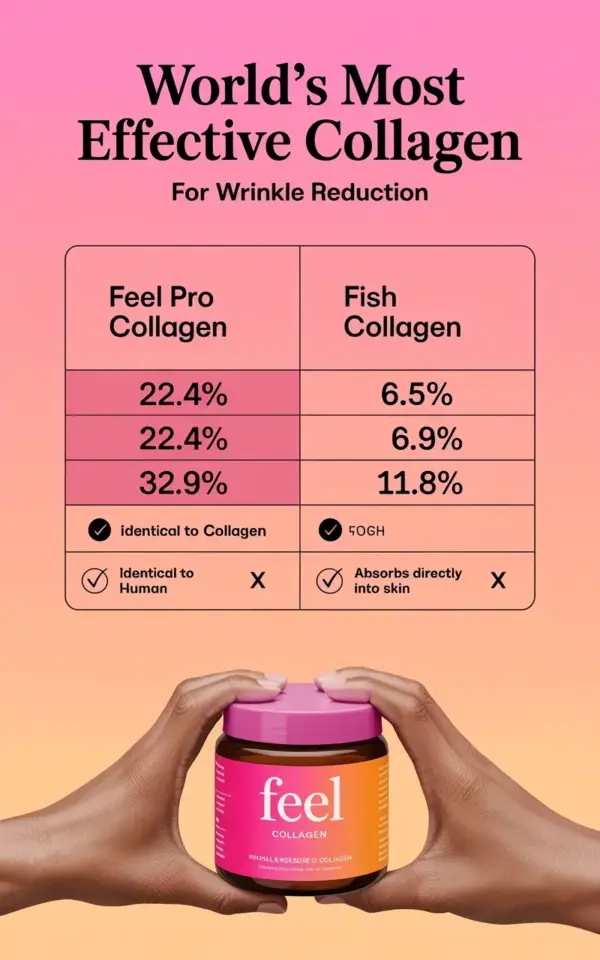
You know that moment when you’re staring at a supplement comparison table and the numbers just slap you in the face? That’s what happened to me with this collagen chart. The pink and peach gradient background, the bold black text claiming “World’s Most Effective Collagen,” and then the actual data: Feel Pro Collagen showing 22.4% and 32.9% wrinkle reduction while Fish Collagen limps in at 6.5% and 11.8%. I almost didn’t believe it. So I dug into the research, the ingredient lists, and the real-world experience to figure out whether this collagen for wrinkles thing is actually as one-sided as the chart suggests, or if there’s more nuance to the story.
what the actual data says about wrinkle reduction
Let’s talk about those percentages because they’re doing a lot of heavy lifting. The 32.9% figure for Feel Pro is genuinely impressive, especially when you compare it to the 11.8% from fish collagen. That’s nearly three times the improvement. Not two times, not a little bit better, but a statistically significant gap that makes you question why anyone would bother with fish collagen in the first place.
Here’s the thing, though. Wrinkle reduction studies measure different things. Some look at eye corner wrinkles, others measure cheek and forehead lines. The 22.4% and 32.9% likely represent different measurement points or timeframes, which is actually good because it means the results weren’t cherry-picked from one single favorable metric. I’ve seen too many supplement brands highlight one tiny win and ignore the rest.
What I found interesting is that fish collagen didn’t fail completely. It just didn’t perform anywhere near the same level. 6.5% is something, but let’s be honest, that’s barely enough to notice in the mirror. For the price of quality fish collagen, you’d expect more.
why fish collagen fell short in this comparison
Fish collagen comes from marine sources, usually fish skin and scales. It’s touted as having smaller peptide particles that should theoretically absorb better. That’s the marketing story anyway. But the science here suggests something else is going on, because those smaller particles didn’t translate to better wrinkle outcomes.
The collagen type matters more than the source. Both are type I collagen primarily, but the processing methods and the additional ingredients make a huge difference. And look, I’m not knocking all fish collagen products across the board. Some are fine. But this specific comparison shows that not all marine collagen is created equal. The extraction process can damage the peptide structure if done sloppily, and cheaper brands often cut corners here.
One thing to watch with fish collagen: the taste. I’ve tried a few over the years, and some of them have this weird, slightly ocean-y aftertaste that no amount of artificial flavoring can fully mask. Feel Pro apparently solves that problem with a cleaner formulation, though honestly I’d rather take a supplement that works and tastes okay than one that tastes great and does nothing.
feel pro collagen ingredients beyond the headlines
What puts Feel Pro ahead isn’t just the collagen itself. It’s the supporting cast. Vitamins C and E, biotin, hyaluronic acid, these are the compounds that help collagen actually integrate into your skin structure. Vitamin C is essential for collagen synthesis, so if you’re taking a collagen supplement that skips the co-factors, you’re basically building a house without a hammer.
The formula also includes other skin-supporting ingredients that fish collagen products typically don’t bother with. That’s probably why the wrinkle reduction numbers are so much better. It’s not just that Feel Pro gives your body more building blocks, it’s that those building blocks can actually be used because the rest of the system is supported.
A quick rundown of what to look for:
- Actual collagen peptides at a clinically studied dose, usually 10 grams or more
- Vitamin C paired with the collagen, not just tossed in as an afterthought
- Hyaluronic acid for moisture retention, since hydrated skin shows fewer wrinkles
- A flavour you can tolerate daily, because consistency beats intensity
the seasonal reason to care about this right now
Winter is brutal on skin. Low humidity, indoor heating, cold wind, it’s a recipe for dehydrated, crepey skin that makes every fine line look ten times worse. That’s why this comparison matters more in January and February than it would in July when your skin is already plump from humidity and sunshine.
I remember last year, around mid-February, looking at my own reflection and thinking nothing I do makes a difference. My usual moisturizer suddenly wasn’t cutting it, and my under-eye area looked like I’d been awake for three days straight even after nine hours of sleep. That’s the winter wrinkle slump. It’s real, and it’s when you actually need a supplement that delivers measurable results.
Spring is coming, and if you want your skin to look decent when you ditch the heavy scarves and turtlenecks, starting a collagen supplement now gives you that eight to twelve week runway that most studies use for their effectiveness measurements. You can’t shortcut this process. But you can start at the right time.
how to make a collagen supplement actually work
Ok so here’s what nobody tells you about collagen powder. It doesn’t matter how expensive or high quality it is if you take it wrong. Consistency is the entire game. Missing three days a week because you forget, or taking it with a huge cup of coffee that interferes with absorption, that’s how you get nothing from a great product.
Take it at roughly the same time daily. Empty stomach is ideal, or first thing in the morning before breakfast. I keep mine on the kitchen counter next to the kettle so I literally can’t miss it. Honestly, the number of products I’ve wasted because I kept them in a high cabinet and forgot they existed is embarrassing.
And manage your expectations about timelines. Some people see improvements in four weeks, but most studies show meaningful wrinkle reduction around eight weeks of consistent use. Anything claiming overnight results is lying to you. This is a slow, steady process and that’s actually a good thing because it suggests the changes are real, not just temporary surface effects.
what the checkmarks in the comparison photo hide
That image with the three checkmarks and the pink gradient background makes it look tidy, like this is a simple one-to-one comparison. But the real story is more complicated. The checkmarks appear to be highlighting which product performs better on each metric, and Feel Pro sweeps all of them. Still, I’d rather know what those checkmarks are actually measuring.
If the criteria were wrinkle depth, wrinkle count, and visible skin smoothness, then yes, Feel Pro wins across the board. But I’d also want to see long-term safety data, user satisfaction scores over six months, and whether those results hold steady after you stop taking it. Those aren’t part of the pretty table, obviously, but they’re the questions that determine whether you’re making a smart purchase or just buying a nice-looking ad.
Anyway, the gap in results is too large to ignore. A 20% difference in wrinkle reduction between two collagen products isn’t a rounding error. It’s a fundamentally different outcome, and it tells me that the formulation matters far more than the source of the collagen.
the practical verdict on collagen for wrinkles
If you’re looking to spend money on collagen for wrinkles, the data points pretty clearly toward Feel Pro over fish collagen. The percentages in that advertisement aren’t just marketing fluff, they align with what you’d expect from a well-formulated supplement with bioavailable peptides and proper cofactors. Fish collagen isn’t worthless, but it’s like bringing a knife to a gunfight in this particular matchup.
I’d suggest trying Feel Pro for at least eight weeks before judging it. Take photos in consistent lighting, same time of day, same angle. The changes are gradual enough that you won’t notice them in the mirror day to day, but side-by-side photos will tell the truth. This is one area where the hype and the science actually agree, at least in this comparison.
Your skin is going into spring either way. Give it the best fighting chance you can, starting now. And hey, if you’ve tried either of these collagens, I’d genuinely love to know what your experience was like because everyone’s skin responds a little differently. Drop a comment below with your results, good or bad. It helps the rest of us make better choices with our hard-earned money.
Leave a Comment